Owner: City of Toronto
Contact: Ryan Duggan, Director of Safety & Compliance
Building Portfolio: Approximately 2,500 City-owned and operated facilities
Installations: Dry Pipe & Pre-Action Systems
Status: Included in City of Toronto Master Specifications for New Construction and Major Re-Piping Projects
Introduction: From Corrosion Investigation to City-Wide Standard
When the City of Toronto began investigating solutions to address corrosion in its fire sprinkler systems, the objective was simple: find a practical, long-term way to protect critical life safety infrastructure.
For Ryan Duggan, Director of Safety & Compliance for the City of Toronto, the search began after experiencing corrosion-related failures in several facilities and evaluating available corrosion mitigation technologies.
“We were looking for a solution to prevent long-term corrosion,” said Duggan. “We immediately saw so many other applications where we could use Vapor Pipe Shield.”
What started as a search for answers on a single project has since evolved into a city-wide standard. Today, Vapor Pipe Shield (VPS) is included in the City of Toronto’s Master Specifications and is installed by default on all new dry pipe and pre-action sprinkler systems as well as major system replacement projects.
The Challenge: Corrosion Failures Across Critical Facilities
Managing fire and life safety systems across approximately 2,500 buildings presents unique challenges. Over the years, corrosion had become a recurring issue in several dry sprinkler systems throughout the City’s portfolio.
In some cases, the damage extended far beyond isolated repairs.
“These are not just simple cases where we’ve got a couple rough branch lines or a bad section of main,” Duggan explained.
At one municipal solid waste transfer station, corrosion had progressed to the point where the entire sprinkler system required replacement.
“We had well over 100 pinhole leaks.”
The facility ultimately underwent a complete re-pipe project, replacing the existing piping and creating an opportunity to implement a long-term corrosion mitigation strategy moving forward.
The Solution: Vapor Pipe Shield
After evaluating available options, the City selected Vapor Pipe Shield for both retrofit and new construction applications.
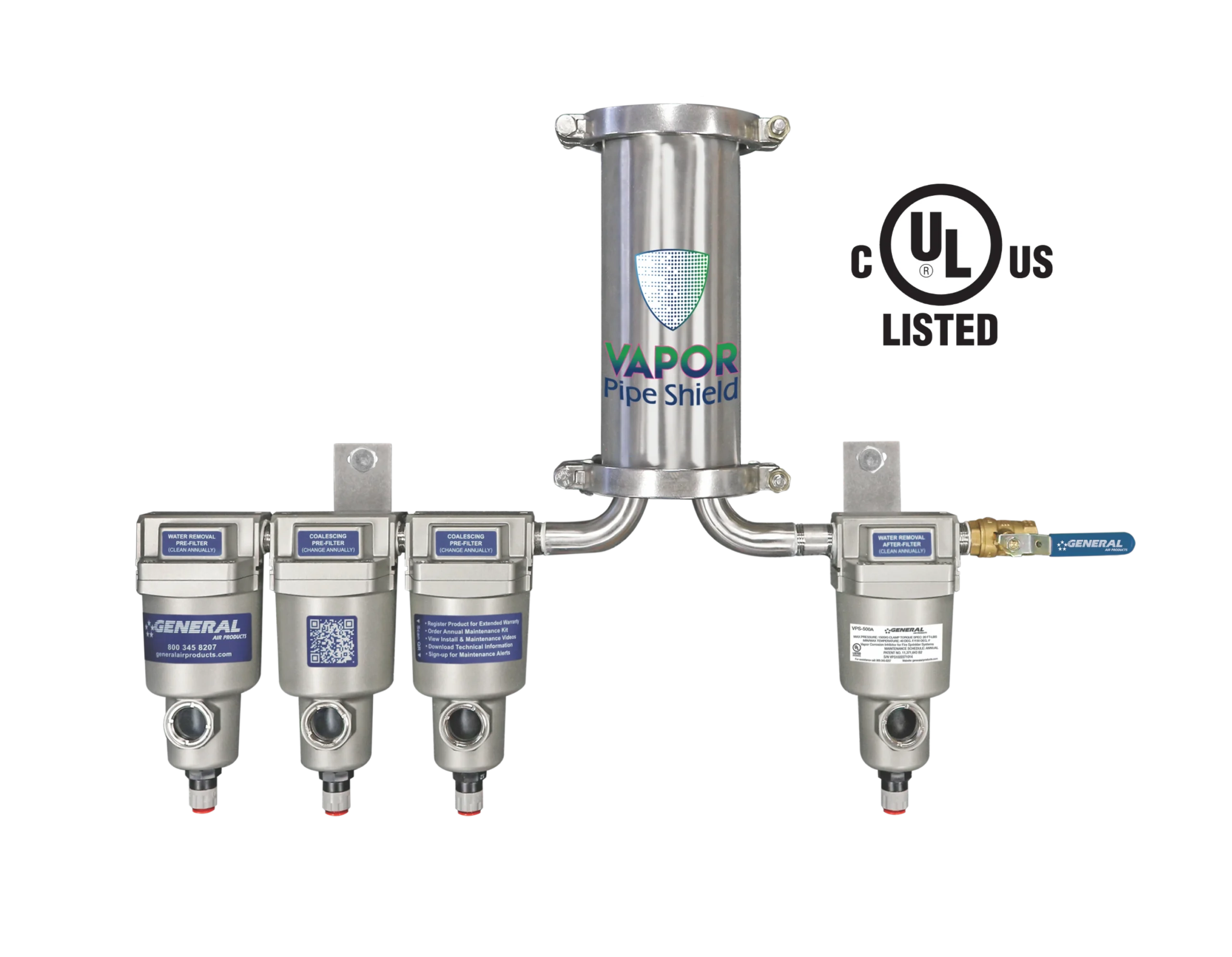
Unlike technologies that require dedicated floor space, complex equipment, or ongoing operational adjustments, VPS offered a straightforward approach that could be easily incorporated into existing facilities and future projects.
“The cost associated with nitrogen, and the floor space that we need, especially in a retrofit application, was just difficult to manage,” said Duggan. “VPS just sticks up on the wall behind the risers. It’s really easy to retrofit in.”
The simplicity of the installation and maintenance requirements made VPS particularly attractive for a large municipal portfolio where consistency and ease of operation are critical.
“Everything with VPS is so much less maintenance. It’s really easy to manage.”
Projects Completed
Encouraged by the success of their first install nearly two years ago, the Impact Fire team has since implemented or spec’d Vapor Pipe Shield in several other locations:
- Toronto Police 41 Division
- Application: New Construction
- System: Parking Garage Dry Systems
- Risers: 3
- VPS was installed as part of the new construction project to provide long-term corrosion protection from day one. “That’s true over at one of our Toronto police stations, 41 Division, which is under construction,” said Duggan. “I suspect I’m never going to touch that system ever again.”The church had suffered repeated leaks and system failures—often at the worst possible times, like before Easter or Christmas services. Vapor Pipe Shield was recommended as a proactive solution to stop further deterioration.
- Metro Hall
- Application: Sprinkler Riser Rebuild
- System: Parking Garage Dry Systems
- Risers: 4
- During a major riser replacement project, VPS was installed to protect all parking garage dry systems supplied by the rebuilt riser. The facility consists of three separate buildings, all experiencing similar corrosion issues due to their 15-year-old dry systems. Duggan’s team has ordered three VPS units to address the problem.
- Solid Waste Management – 50 Ingram Transfer Station
- Application: Complete System Re-Pipe
- Facility Size: Approximately 250,000 ft²
- Risers: 12
- After experiencing more than 100 pinhole failures, the entire dry sprinkler system was replaced. Schedule 10 pipe was upgraded to Schedule 40 pipe, and VPS was installed as part of the corrosion mitigation strategy. “We put in VPS there, and that’s been steady for four years,” said Duggan. “I expect that we’ll be in great shape moving forward, well beyond my retirement.” The facility operates multiple dry systems, including two larger systems without accelerators.
- Solid Waste Management – 1 Transfer Place Transfer Station
- Application: Complete System Re-Pipe (Planned)
- Facility Size: Approximately 350,000 ft²
- Risers: 16
- Following severe corrosion and more than 150 pinhole failures, the City has scheduled a complete system replacement for construction in 2026. VPS will again be incorporated as part of the project.
From Successful Projects to Standard Practice
Perhaps the strongest endorsement of Vapor Pipe Shield came after the City evaluated the performance of its early installations.
Rather than limiting the technology to a handful of projects, Toronto elected to incorporate VPS into its construction standards moving forward.
“Following the success of that project, we included VPS within our master specifications.”
Today, the City’s standard approach is straightforward:
“It’s in our base specifications now that VPS is mandatory on all dry systems, as well as our pre-action systems, moving forward to prevent premature system failure.”
Looking Ahead
For the City of Toronto, the decision ultimately came down to long-term asset protection.
A relatively small investment during construction or renovation can help avoid significant future maintenance costs, disruptions, and capital replacement projects.
“A little money up front is so much easier to manage versus having to re-pipe sprinkler systems.”
Duggan believes the value proposition is simple.
“Why wouldn’t you spend $1 now to save $20 down the road if it’s really going to work and limit all the associated headaches that come with that down the road?”
As municipalities, property owners, and facility managers continue to look for ways to extend the life of their fire protection infrastructure, the City of Toronto’s experience demonstrates how Vapor Pipe Shield can serve as a practical and scalable corrosion mitigation solution.
“This is proven technology. It’s working very well for us.”
“There hasn’t been an innovation like this in dry sprinkler pipe corrosion protection in a long time.”

Ryan Duggan
Director of Safety & Compliance – City of Toronto
Click below to read other Vapor Pipe Shield case studies.