Unified Facilities Criteria (UFC) no longer requires nitrogen for dry and pre-action fire sprinkler systems. The July 2026 revision of UFC 3-600-01, Fire Protection Engineering for Facilities , the standard that governs fire sprinkler systems in all facilities associated with the Department of Defence (DoD) and its affiliated agencies, removes the previous prescriptive nitrogen requirements for dry pipe and pre-action sprinkler systems. Nitrogen is still permitted, but it is no longer mandated as the corrosion-control approach.
That marks a significant change in the Department of Defense’s treatment of corrosion control. Over the previous decade, nitrogen went from a limited requirement for certain pre-action systems to a broader requirement affecting both pre-action and dry pipe systems.
The 2026 revision moves away from that prescriptive approach and gives project teams more flexibility to evaluate corrosion-control strategies based on system conditions, maintenance requirements, lifecycle cost, and performance.
How Did the UFC Nitrogen Requirement Evolve?
Nitrogen was first added to UFC 3-600-01 in February 2013.
At that time, Section 4-2.3.2.1 required nitrogen in lieu of air for certain Navy and Air Force pre-action systems.
The requirement expanded over the next several years:
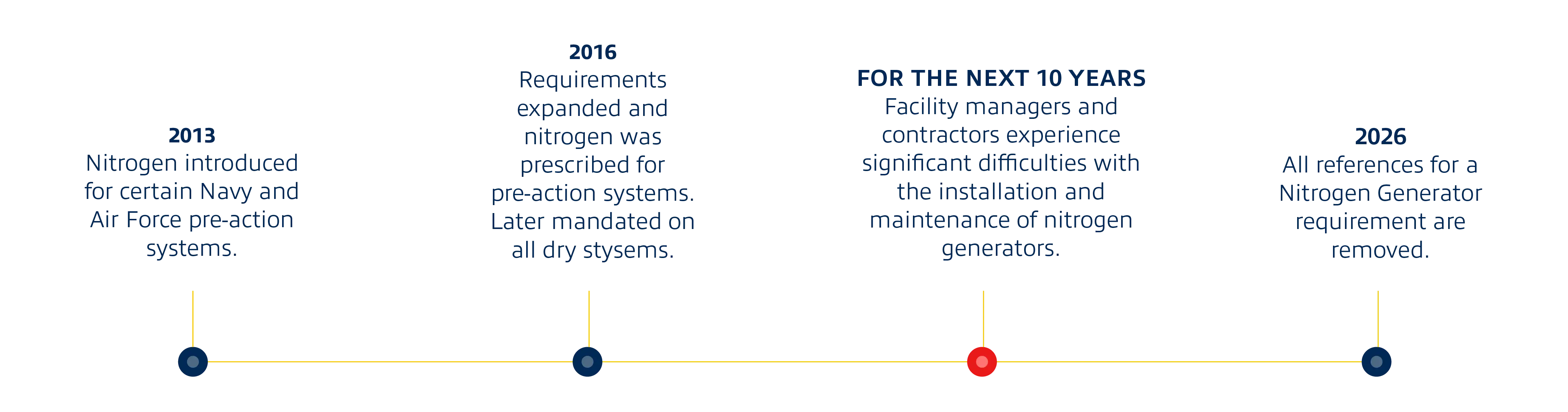
By 2018, nitrogen had become the required approach for applicable dry and pre-action sprinkler systems within DoD facilities.
That remained the status quo until the July 2026 revision.
What Changed in 2026?
The current version of UFC 3-600-01 no longer contains the previous dedicated nitrogen-generation section or the blanket requirement to use nitrogen in dry and pre-action systems.
Instead, the UFC now relies more broadly on NFPA 13 requirements unless specifically modified by the UFC.
This does not prohibit nitrogen. It simply means designers are no longer required to begin with nitrogen as the default corrosion-control strategy.
Why Was the Nitrogen Requirement Removed?
The current UFC does not explain why the requirement was removed.
Because of that, it would be inaccurate to attribute the change to any single issue. However, several industry considerations help explain why a more flexible approach may make sense.
System Conditions Vary
Dry and pre-action systems differ significantly in piping layout, system volume, trapped water, leakage, climate, age, and maintenance practices.
A blanket nitrogen requirement could force expensive equipment upgrades on facilities where nitrogen may not be the most appropriate or cost-effective solution. For instance, the cost of installing and maintaining a Vapor Pipe Shield is significantly more cost-effective than nitrogen.
Nitrogen Generators Add Equipment and Maintenance
A Nitrogen Generator requires a compressor, purge equipment, analyzers, controls, additional accessories, and ongoing monitoring. When nitrogen was introduced the cost of ownership was expected to be offset by the ability to use different piping options and allowing the system to have longer lifespan. Many installations are not realizing these benefits and cost savings.
That added complexity and cost can be appropriate in some applications, but not necessarily in every system.
Nitrogen Concentration Can Vary Throughout the System
A generator producing 98% nitrogen does not necessarily mean the entire sprinkler system contains 98% nitrogen.
Testing published in Sprinkler Age found that nitrogen concentration could vary significantly throughout sprinkler piping depending on system layout, leakage, and purge method.
That matters because the corrosion-control benefit depends on achieving and maintaining the intended environment throughout the system, not simply at the generator or purge point.
What air supply options can just be considered?
Anything that is acceptable by NFPA standards. This includes:
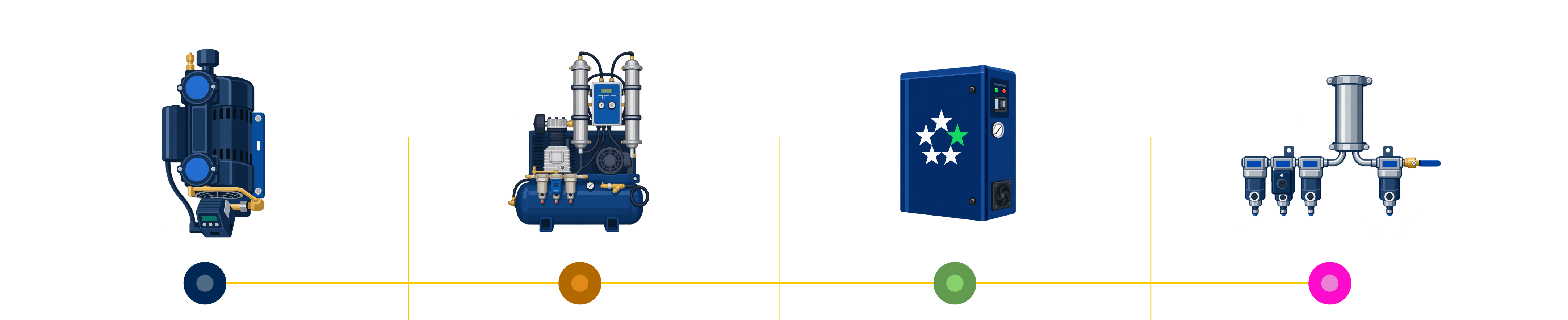
Compressed Air
By itself will not reduce corrosion but is the traditional air supply for dry and pre-action systems. Existing systems with an air compressor can simply add a Vapor Pipe Shield unit to address any corrosion concerns.
Dry Air
Dry-air systems reduce the amount of moisture introduced into the sprinkler system, helping address one of the conditions that contributes to corrosion. Dry air is ideal for cold storage facilities or other installations where moisture removal is essential.
Vapor Corrosion Inhibitors
Vapor corrosion inhibitors use corrosion-inhibiting technology that travels through the sprinkler piping and forms a protective molecular layer on metal surfaces.
General Air Products’ Vapor Pipe Shield™ is a UL Listed vapor-phase corrosion inhibitor delivery system designed for dry pipe and pre-action sprinkler systems.
What Does This Mean for Dry Systems in US Government Facilities?
The 2026 UFC revision gives designers, and facility teams more discretion when selecting a corrosion-control strategy.
Instead of beginning with a mandatory nitrogen requirement, teams can evaluate factors such as:
- System configuration
- Leakage
- Trapped water
- Maintenance requirements
- Equipment complexity
- Lifecycle cost
- Corrosion-control performance
The key change is the flexibility to use more effective and cost efficient alternatives like dry air, vapor corrosion inhibitors or a listed fire protection air compressor.
Conclusion
The 2026 revision of UFC 3-600-01 represents a clear shift in how those responsible for fire sprinkler systems in US Government facilities approach corrosion control in dry and pre-action sprinkler systems.
Nitrogen remains an available option, but it is no longer the prescribed solution for every applicable system.
That gives designers and facility teams more flexibility to select a corrosion-control strategy based on actual system conditions, maintenance requirements, cost, and long-term performance.
For technologies such as Vapor Pipe Shield™, that creates an opportunity to be evaluated for use rather than being excluded by a mandate for an older technology.
Is nitrogen still allowed in DoD dry and pre-action sprinkler systems?
Yes. Nitrogen is still permitted. It is simply no longer required by UFC 3-600-01, which allows for the use of other corrosion mitigation products like Vapor Corrosion Inhibitors.
What is the Unified Facilities Criteria?
The Unified Facilities Criteria (UFC) are technical standards used by the U.S. Department of Defense for the planning, design, construction, renovation, and maintenance of military facilities.
UFC documents cover a wide range of building systems, including fire protection, structural design, mechanical systems, electrical systems, security, and other facility requirements. For fire protection, UFC 3-600-01, Fire Protection Engineering for Facilities, establishes DoD-specific requirements.
When did the DoD begin requiring nitrogen?
Nitrogen was first required for certain Navy and Air Force pre-action systems in 2013. The requirement expanded over the following years and was extended to dry pipe systems by 2018.
When was the nitrogen requirement removed?
The nitrogen-specific requirements were removed in the July 2026 revision of UFC 3-600-01.
Does 98% nitrogen at the generator mean 98% nitrogen throughout the sprinkler system?
No. Nitrogen concentration can vary throughout a system depending on piping layout, leakage, and purge method.
What are the alternatives to nitrogen?
Depending on the project, alternatives can include compressed air, dry air, and vapor corrosion inhibitor technology.